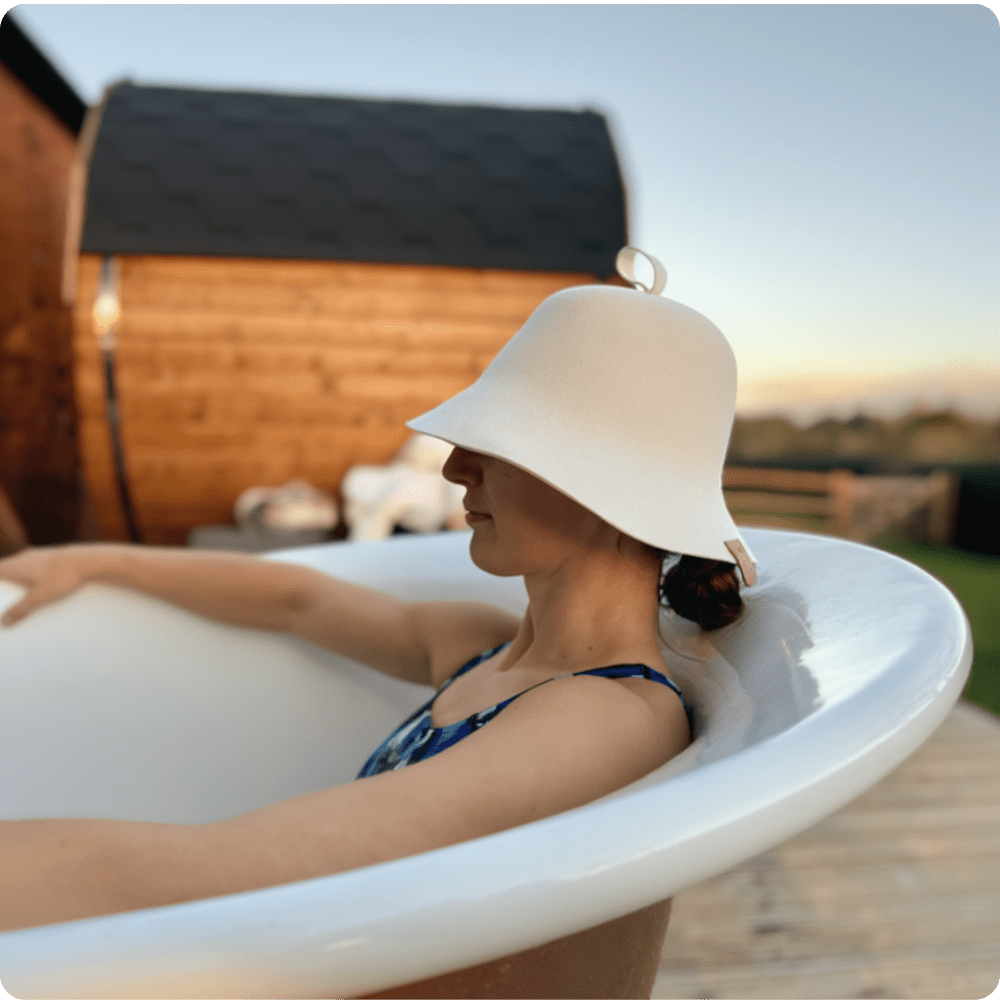
Why Wear a Hat in the Sauna?
You've seen them. Felted wool hats sitting on heads in the hottest room at the spa, looking a bit odd next to all that bare skin. Then you try a sauna without one, your scalp starts prickling within minutes, you can't stay in as long, and you get it straight away.
A sauna hat protects your head and hair from the extreme heat inside a sauna, where temperatures usually sit between 80–100°C. Your head doesn't have much natural defence against that kind of heat, unlike the rest of your body.
The short answer: Your head is one of the most heat-sensitive parts of your body. It has thinner protective tissue than almost anywhere else. In a sauna at 80–100°C, your scalp and hair take the worst of it. A wool sauna hat insulates your head, slows moisture loss from your hair, and lets you stay in longer without your head overheating first.
What actually happens to your head in a sauna
Here's the bit most people don't think about until it's too late: a Finnish-style sauna typically sits between 80°C and 100°C, with some hotter still. That's extreme heat- hot enough that a few centimetres of skin and hair are closer to that air than almost any other part of you.
Your scalp doesn't sweat as efficiently as the rest of your body, and it has less insulating fat underneath it than areas like your torso or thighs. Your hair has even less defence, especially if it's fine, dry, or colour-treated. Ask anyone who's skipped the hat on a long session and you'll hear the same thing- eventually it leads to dry, brittle-feeling hair for a day or two after, a tight and sore scalp, sometimes a headache an hour later that nobody connects back to the sauna.
That's usually the moment people decide they need a hat. Not from reading about it- from how their hair & head feels post-sauna sessions.
Do sauna hats actually work?
Yes. And the reason is simple physics, not wellness marketing. A sauna hat works as a thermal barrier. It sits between your scalp and the hot air around it, slowing down how quickly that heat reaches your head and hair.
Wool does this well, and merino especially. Its fibres trap tiny pockets of still air, and still air is a poor conductor of heat- exactly what you want between your scalp and a 90°C room. The same structure works in reverse in winter clothing, which is why you've probably seen merino base layers turn up on mountains as often as they do in saunas.
Merino also deals with moisture differently to synthetic materials. It's hygroscopic, meaning it takes water vapour into the fibre itself rather than just sitting on the surface. It can hold close to a third of its own weight in moisture before it starts to feel damp. In a sauna, that means the hat is managing sweat and steam around your head instead of trapping it against your skin the way a synthetic hat would.
So the honest answer to "do sauna hats work" is yes- but the material matters a lot. A thin polyester cap won't do much beyond keeping your hair off your face. Proper wool felt, at 2–2.5mm thick, is doing real work.
Sauna hat benefits: what you'll actually notice
Most sauna hat marketing leans hard into vague wellness language. Here's what regular sauna-goers actually say (including me!):
- You can stay in longer. Without your head overheating first, you get more out of the session itself- the part where your core temperature rises and you get the benefit people go to saunas for.
- Your hair stops taking the damage. Repeated dry heat above 80°C dries hair out over time. A hat stops that.
- No more scalp burning or tightness. That prickling, sunburnt feeling on your scalp after a long session mostly disappears.
- Fewer overheating headaches. Not universal, but common enough that a lot of regular users mention it.
- It's simply more comfortable. Less worrying about how hot your head feels means more actual relaxation- which is the whole point of being in there.
There's decent research behind sauna use generally, even if it doesn't focus on hats specifically. A well-known Finnish study followed over 2,300 men for two decades and found that frequent sauna bathing was associated with a significantly reduced risk of sudden cardiac death and fatal cardiovascular disease, with the strongest effect in men using a sauna four to seven times a week. That's a solid, peer-reviewed finding, and it's a good reminder of what a hat can help support. It's not novelty- it's letting you complete the full session that gets you those benefits, instead of cutting it short because your head can't take it. American College of Cardiology
Do you need a sauna hat, or is it optional?
It really depends how you use saunas. If you pop in for five minutes after a swim, you'll probably be fine without one. If you're doing proper sessions- 15 to 20 minutes, several rounds, a few times a week- a hat stops being a nice-to-have and becomes the thing that lets you actually finish the session comfortably.
It matters more if you have fine or colour-treated hair, if you already know you're heat-sensitive, or if your sauna runs hot- some home and spa saunas sit right at the top end of that 90–100°C range. It matters less if you're an occasional visitor doing short, cooler sessions. Most people overthink this. If you already have a sauna routine, get the hat. If you're testing the waters with one visit a month, it can probably wait.
Merino wool vs other sauna hat materials
Not all sauna hats are equal, and the material is really the whole story.
Synthetic felt or polyester blends are common because they're cheap. They don't insulate especially well, and they're not built for repeated extreme heat- some cheaper synthetics can degrade, which isn't something you want anywhere near your head (particularly when there's heat involved too!).
Cotton towelling hats soak up sweat but don't insulate much. They get heavy and damp fast, which defeats the point.
Merino wool, properly felted and thick enough (2–2.5mm is the sweet spot- thin enough to be comfortable, thick enough to actually insulate), handles heat, moisture, and repeated use better than either. It's also naturally odour-resistant, which matters more than you'd think once a hat's been through a few sweaty sessions!
Honestly, a lot of cheap sauna hats on the market don't do much. Either the felt's too thin, or it's synthetic and shouldn't be that close to your head at 90°C.
FAQ
Q: Do sauna hats actually work?
A: Yes. Wool sauna hats insulate your scalp from the heat and manage moisture from sweat and steam, letting you stay in the sauna longer and more comfortably.
Q: Why does my head get so hot in the sauna?
A: Your scalp has less insulating fat than most of your body and sweats less efficiently in extreme heat, so it heats up faster than the rest of you in a room at 80–100°C.
Q: What's the best material for a sauna hat?
A: Merino wool, at least 2mm thick. It traps insulating air pockets, absorbs moisture without feeling wet, and holds up to repeated heat far better than synthetics or cotton.
Q: Do I need a sauna hat every time I use the sauna?
A: Not necessarily for short, occasional visits. For regular sessions of 15 minutes or more, most people find a hat makes a real difference to comfort and how long they can stay in.
Q: Can a sauna hat protect coloured or damaged hair?
A: Yes. Repeated dry heat above 80°C dries hair out over time, and a wool hat cuts down that exposure a lot.
Q: Is it weird to wear a hat in the sauna?
A: Not at all- you'll probably have seen others wearing them before. It's more about function, than fashion (though we do like to think our Sauna Kind hats bring fashion to your protocol!).
If you're ready to try one properly made, our merino wool sauna hat is hand-shaped from a single piece of 100% Australian merino, 2–2.5mm thick, no seams to dig in or fall apart with wear. Give it a go- we'd love to hear how you find the difference.